


Monuments |
Monuments and Historic Landmarks of Kyiv
Kyiv is a city where history is literally set in stone. Its squares and hilltops are populated with monuments spanning twelve centuries of statehood, faith, culture and national memory. Whether you are a first-time visitor or a returning traveller, these landmarks are essential stops on any Kyiv itinerary.
Golden Gate (Zoloti Vorota)
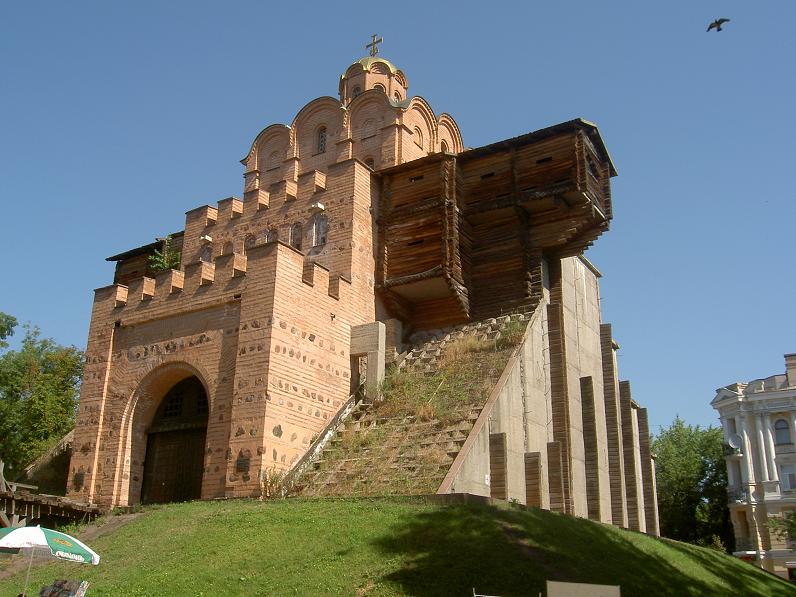
The Golden Gate (Ukrainian: Zoloti Vorota) was the main ceremonial entrance to the ancient walled city of Kyiv, built in 1037 under Prince Yaroslav the Wise as part of his grand plan to transform Kyiv into a Christian capital to rival Constantinople. The name was a direct homage to the Golden Gate of Constantinople. The structure consisted of a massive defensive tower some 12 metres tall with a 6-metre-wide passageway, topped by the gilded-domed Annunciation Church — fulfilling a vow Yaroslav made to the Virgin Mary before his decisive victory over the Pecheneg tribes. [web:974][web:976]
The gate was severely damaged during the Mongol invasion of 1240, when the Golden Horde breached the city through the less-fortified Liadski Gate. Over subsequent centuries the ruins gradually subsided and were deliberately covered with earth in 1751 to preserve what remained. Archaeological excavations began in 1832. In 1982, to mark the 1,500th anniversary of Kyiv, a full reconstruction of the gate was completed, enclosing and protecting the original 11th-century masonry. Today the gate houses a small but informative historical museum with original medieval artefacts, and visitors can climb to the top of the 29-metre pavilion for views over the surrounding neighbourhood. A bronze statue of Yaroslav the Wise stands directly in front of the gate. [web:977][web:979][web:982]
Address: 40A Volodymyrska St, Kyiv | Nearest metro: Zoloti Vorota (green line)
Monument to Yaroslav the Wise
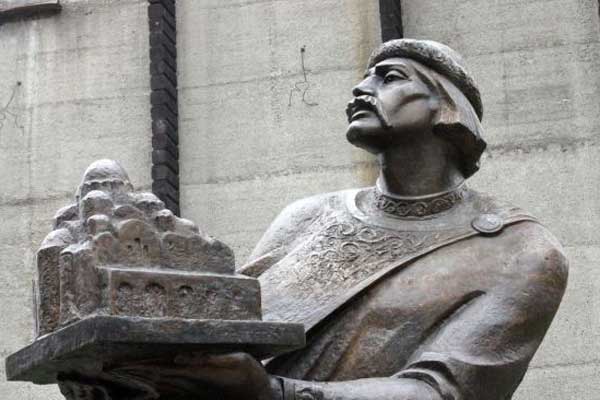
Yaroslav I (c. 978–1054), known to history as Yaroslav the Wise, was Grand Prince of Kyiv from 1019 to 1054 and one of the most consequential rulers in the history of Eastern Europe. Under his reign, Kievan Rus reached the peak of its political power and cultural brilliance. He commissioned the construction of St Sophia′s Cathedral and the Golden Gate, founded the first known library in Rus, established schools for boys and girls, issued the legal code Ruska Pravda, and promoted the translation of Greek religious and scholarly texts into the Slavic language. He sealed diplomatic alliances across Europe through the marriages of his children to the royal houses of France, Norway, Hungary and Poland — earning him the nickname “father-in-law of Europe.” [web:974]
The bronze monument to Yaroslav the Wise was unveiled in 1997 and stands in the square in front of the Golden Gate. It depicts the prince holding a model of St Sophia′s Cathedral in his outstretched hands. Kyivites affectionately nicknamed it “the monument to the Kyiv cake” — for reasons that become obvious the moment you see the cathedral-shaped object in his hands.
Monument to Bohdan Khmelnytsky
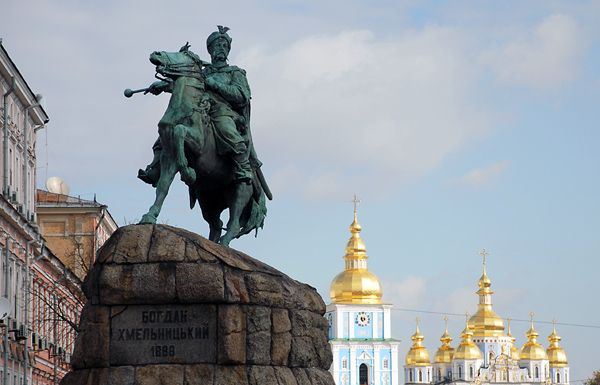
One of the most recognisable monuments in Kyiv stands on Sofiyska Square, directly in front of St Sophia′s Cathedral: the equestrian statue of Hetman Bohdan Khmelnytsky (1595–1657), leader of the Zaporozhian Cossack Hetmanate and commander of the Ukrainian Cossack uprising against the Polish-Lithuanian Commonwealth (1648–1657). Khmelnytsky remains one of the most complex and debated figures in Ukrainian history — a brilliant military commander and statesman who led Ukraine toward a degree of autonomy, and whose image appears on the five-hryvnia banknote.
The bronze statue, created by sculptor Mykhailo Mykeshin and unveiled in 1888, shows Khmelnytsky mounted on horseback, his mace raised toward the sky. It is one of the oldest and most artistically significant public monuments in Kyiv. In January 1649, Khmelnytsky made his triumphal entry into Kyiv through the Golden Gate after his victory over Polish forces, and was greeted by the city′s Metropolitan and crowds of jubilant citizens — a moment depicted in many Ukrainian historical paintings.
Prince Volodymyr Monument
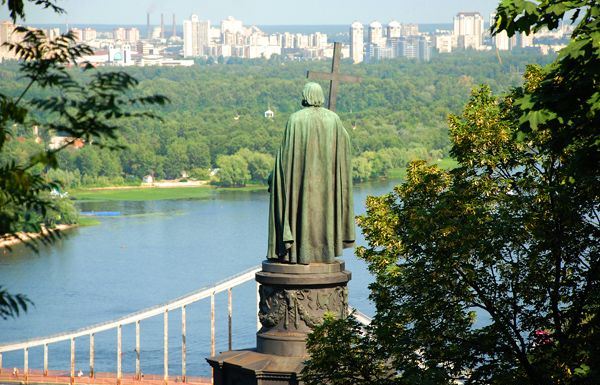
Perched on the steep Volodymyrska Hill above the Dnipro River, the Monument to Prince Volodymyr is one of the most iconic silhouettes in Kyiv and the symbolic guardian of the city. It commemorates Grand Prince Volodymyr the Great (c. 958–1015), who in 988 adopted Christianity as the state religion of Kievan Rus and ordered the mass baptism of the population in the waters of the Dnipro — one of the most pivotal events in the history of Eastern Europe. Volodymyr was later canonised as a saint equal to the Apostles.
During his reign, the first schools and stone churches were built in Kyiv, including the magnificent Church of the Tithes (Desyatynna Church). He expanded the borders of Kievan Rus significantly and forged diplomatic and dynastic ties with the Byzantine Empire, Bulgaria and the German states. The bronze statue, standing on a cast-iron pedestal with a large cross in the prince′s hand, was erected in 1853. It is visible from the river and from the opposite Left Bank, particularly at night when it is illuminated.
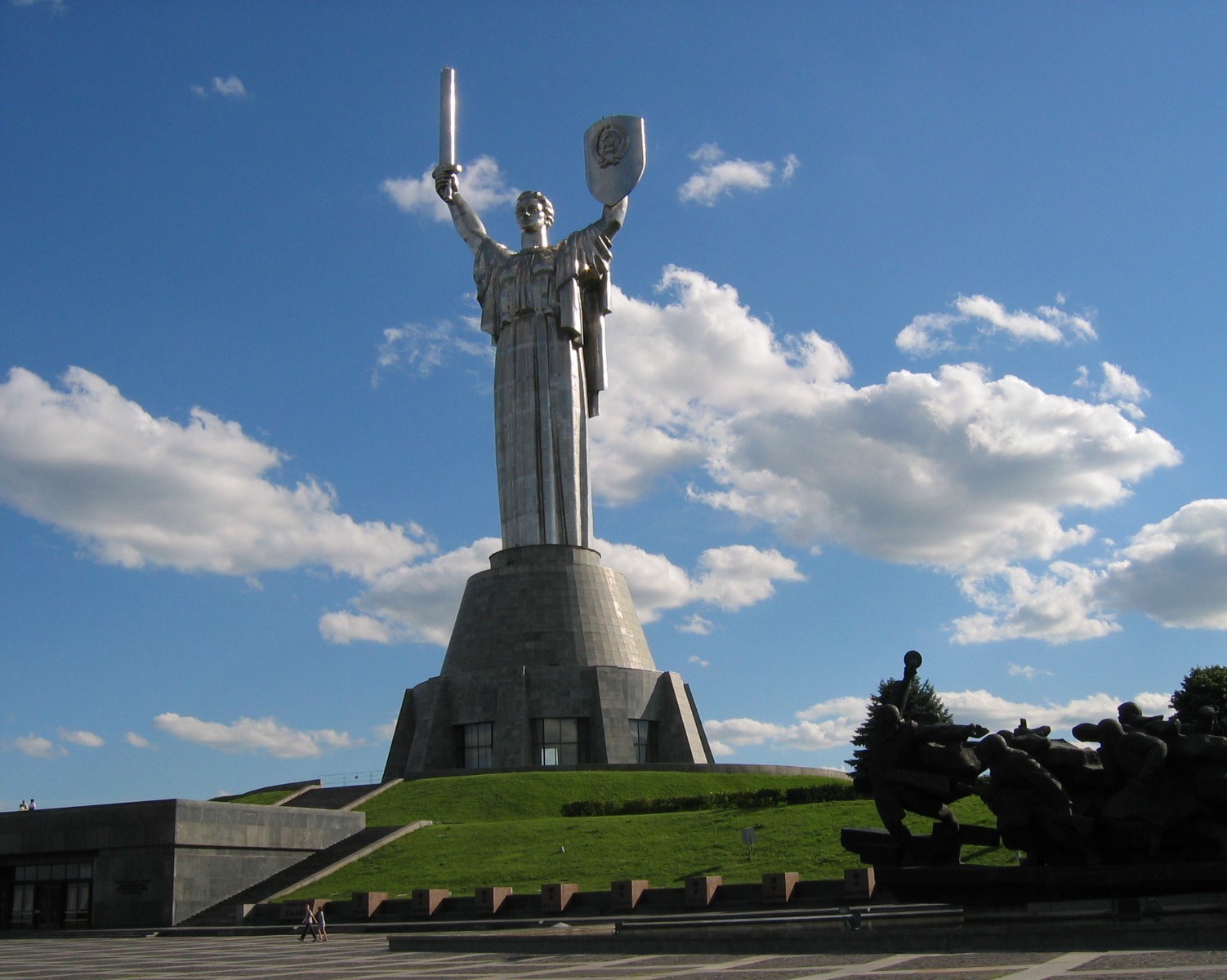
The Motherland Monument
Rising 62 metres above its base (102 metres in total height), the Motherland Monument (Rodina-Mat) is the most physically imposing landmark in Kyiv. The stainless-steel figure of a woman holding a sword and shield was built in the workshops of the Zaporizhzhya steelworks and completed at Kyiv′s Paryska Komuna factory with the technical assistance of the Paton Institute of Electric Welding. It was inaugurated in 1981. The figure weighs approximately 450 tonnes, the sword alone weighs 9 tonnes and measures 16 metres in length, and the entire structure is engineered to withstand a magnitude-9 earthquake. [web:972]
In 2023, as a powerful act of national de-Sovietisation, the Soviet coat of arms on the shield was officially replaced with the Ukrainian trident (tryzub). The monument is part of the National Museum of the History of Ukraine in World War II, whose grounds contain an extensive outdoor exhibition of WWII-era military equipment, memorials, and sculptures. Two lifts inside the statue once allowed visitors to ascend into the head and sword, though access to those areas is currently limited.
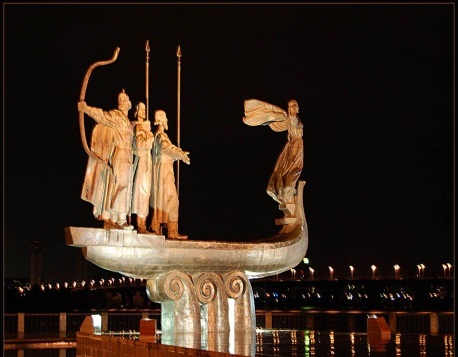
Monument to the Founders of Kyiv
Standing on the bank of the Dnipro at the foot of the Pechersk plateau, the Monument to the Founders of Kyiv is one of the most photographed riverside landmarks in the city. Unveiled in 1982, it was created by sculptor Vasyl Borodai and architect M. Feshchenko. The sculpture depicts a long boat with the legendary founders of Kyiv: the three brothers Kyi, Shchek and Khoriv, and their sister Lybid. Kyi stands at the centre holding a large bow; his brothers carry spears; and Lybid stands at the prow, her cloak billowing in the wind, gazing toward the future of the city they founded.
According to the Kyivan Primary Chronicle, the city of Kyiv was founded by these four siblings, and named after the eldest brother, Kyi. The monument has become a symbol of Kyiv′s ancient origins and its position as one of the oldest cities in Eastern Europe.
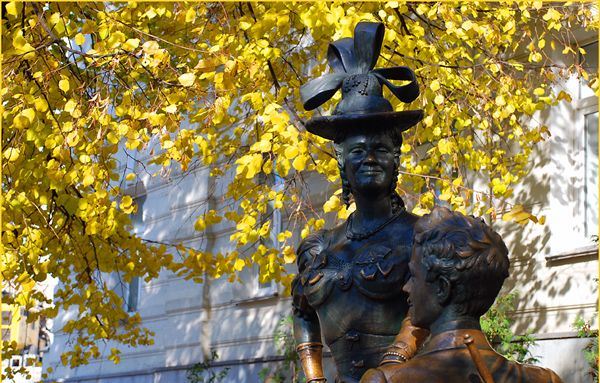
Pronya Prokopivna and Svirid Holokhvastov
Not all of Kyiv′s monuments are solemn. At the top of Andriivsky Uzviz, on Desyatynna Street, stands one of the most beloved and cheerful sculptures in the city: the bronze figures of Pronya Prokopivna Syrkova and Svirid Petrovych Holokhvastov, the immortal comic couple from Mykhailo Starytsky′s play Za dvoma zaytsiamy (“Chasing Two Hares”), popularised by the cult 1961 Ukrainian film of the same name. Unveiled in 1999, the monument quickly became one of the most visited photo spots in Kyiv.
Pronya′s waist has been polished to a warm golden shine by the hands of thousands of tourists who have embraced her for photographs. There is often a cheerful queue. The monument sits in one of Kyiv′s most atmospheric corners — at the very entrance to the historic Andriivsky Uzviz, the cobbled street that descends through the old city past art galleries, cafes and the Bulgakov Museum.
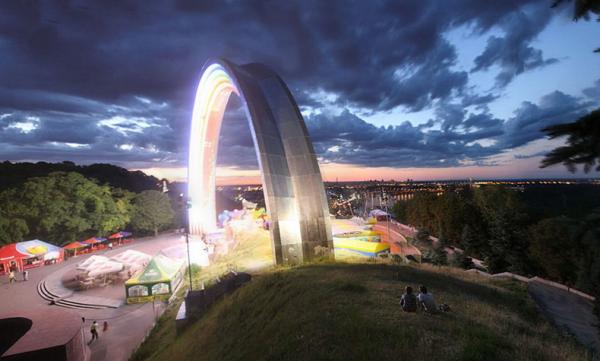
The Arch of Unity (Former Arch of Peoples′ Friendship)
The large rainbow-shaped arch that once stood in Khreshchatyi Park above the Dnipro was erected in 1982 to mark the 1,500th anniversary of Kyiv. For decades it was known as the “Arch of Peoples′ Friendship” and served as a popular viewpoint over the river and the Left Bank. In April 2022, following Russia′s full-scale invasion of Ukraine, the monument′s central sculptural group — two bronze figures symbolising the union of Ukraine and Russia — was dismantled by the city authorities. The arch structure itself remains and the viewing platform continues to offer one of the finest panoramas of the Dnipro in Kyiv. The site is undergoing a gradual reimagining as a space of Ukrainian national identity.
These landmarks can all be visited on a single day′s walking tour of Kyiv′s historic centre, Upper Town and riverfront. Our experienced guides can bring the stories behind every monument to life. To arrange a private or group tour, please contact us via our Contacts page or use the booking form.
