



Great inhabitans of Kiev |
Famous People Born in Kyiv
Kyiv has given the world writers, artists, dancers and statespeople whose names are known on every continent. Here are four extraordinary figures who were born in this city and left a mark on world history, art and culture that endures to this day.
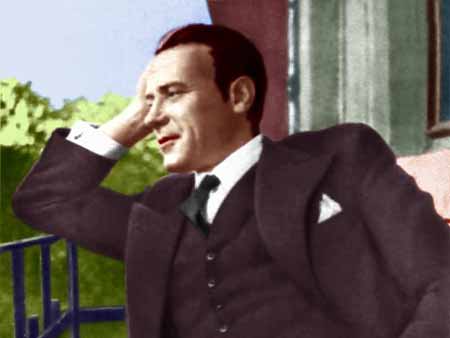
Mikhail Bulgakov
“Those marvellous stars over the Ukrainian sky! I have been living in Moscow for about seven years, but I still long for home. I sometimes feel so homesick that I would take the first train just to see the steppes covered with snow once more… the Dnipro… There is no city as beautiful as Kyiv.”
Mikhail Bulgakov (1891–1940) was born and raised in Kyiv, and his love for the city never left him, even after he moved to Moscow to pursue a literary career. His father was a professor at the Kyiv Theological Academy, and both grandfathers were priests. Bulgakov was named in honour of Archangel Michael — the heavenly patron of Kyiv.
His family moved frequently around the city before finally settling at 13 Andriivsky Uzviz, where Bulgakov lived for twelve years. It was here that he practised medicine, housed his large family, and began to write. Today the building is the Bulgakov Museum, one of the most visited literary sites in Kyiv.
In 1919, during the Civil War, Bulgakov was mobilised as a military doctor and left Kyiv. He eventually made his way to Moscow, where his creative career proved exceptionally difficult: his plays were banned, his novels refused by publishers, and even a personal appeal to Stalin brought no relief. Working as a translator and writing librettos for the Bolshoi Theatre, Bulgakov devoted his remaining years to his masterpiece — The Master and Margarita. He completed the final chapter just one month before his death, dictating the last pages to his wife from his sickbed. The novel was first published only in 1966 — more than twenty-five years after his death — and immediately became a world classic.
Kazimir Malevich
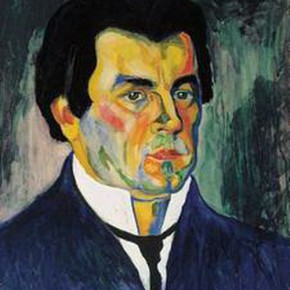
Kazimir Malevich (1879–1935) was born on the outskirts of Kyiv to a Ukrainian family. His father managed sugar refineries, and the work required the family to move constantly through Ukrainian towns and villages — it was in these rural landscapes, surrounded by sugar-beet fields and the colours of the Ukrainian countryside, that the future pioneer of abstract art first opened his eyes to the visual world.
The turning point came on a childhood visit to Kyiv, when young Kazimir noticed a painting in a shop window depicting a girl peeling potatoes. That simple image sparked a lifelong obsession. At fifteen his mother gave him his first box of paints. He entered the Kyiv Art School at seventeen, and in 1904 left for Moscow to continue his studies.
Malevich went on to create Black Square (1915), one of the most radical and discussed works in the history of art, and founded the Suprematism movement — an entirely new visual language based on pure geometric form and colour. For all his international fame, Malevich always felt a pull back to Kyiv. He worked at the Kyiv Art Institute from 1928 to 1930, but Soviet authorities viewed his ideas with growing hostility. His 1930 Kyiv exhibition was savagely criticised in the official press, and shortly afterwards he was arrested and held for several weeks. He spent the final years of his life in official isolation and died in 1935.
Serge Lifar
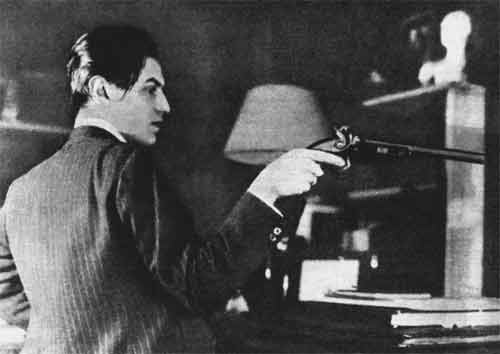
Serge Lifar (1905–1986), described by critics as the “guardian angel of 20th-century ballet”, was born in Kyiv into a prosperous family. From childhood he sang in the choir of St Sophia Cathedral, studied violin, attended the piano class at the Kyiv Conservatoire and enrolled in the ballet school of the legendary Bronislava Nijinska. When Nijinska emigrated to Paris and was invited to join Sergei Diaghilev’s Ballets Russes, she brought her most gifted pupils with her — Lifar among them.
His rise was extraordinary. By 1929 — just a few years after arriving in Paris with almost nothing — Lifar had become the artistic director of the Paris Opéra Ballet, a position he held for more than thirty years. He choreographed over 200 ballets, introduced the formal study of dance theory and history at the Sorbonne, founded the Paris Institute of Choreography, and served as honorary president of the National Dance Council of UNESCO.
Yet through all his decades of Parisian glory, Lifar’s heart remained in Kyiv. “Even beautiful and brilliant Paris could not make me, a Kyivan, forget my wide and majestic Dnipro,” he said. When General de Gaulle awarded him the Légion d’Honneur and invited him to take French citizenship, Lifar replied: “I am Ukrainian and I am proud of that.” He chose to remain stateless rather than renounce his origins. He wished for just four words on his grave in Paris: “Serge Lifar from Kyiv.”
Lifar visited Kyiv only once in his lifetime — in 1961. After his death, his wife donated his most treasured possessions to Ukraine: the Légion d’Honneur, his diamond-encrusted Golden Pointe, stage costumes and sculptural portraits. His legacy lives on in Kyiv through the Serge Lifar International Ballet Competition, which draws dancers and choreographers from across the world.
Golda Meir
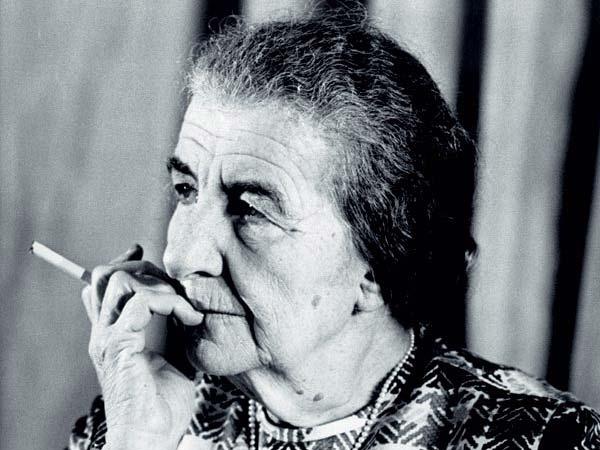
Golda Meir (1898–1978) was born in Kyiv and emigrated with her family to Milwaukee, Wisconsin, in 1906. Few people who left Kyiv as young children have gone on to shape world history as profoundly as she did.
In 1921, she and her husband Morris Meyerson moved to then-Palestine, where she threw herself into the labour and Zionist movements with characteristic intensity. She was one of the signatories of Israel’s Declaration of Independence in 1948 — one of only two women to sign that founding document. She served as Minister of Labour (1949–1956), Foreign Minister (1956–1965), and Secretary-General of the Mapai Party before being nominated, on 7 March 1969, as Prime Minister of Israel — only the third woman in the world to hold the office of prime minister at that time.
She led Israel through one of its most testing moments — the Yom Kippur War of October 1973 — and resigned in June 1974. Known for her directness, moral courage and deep commitment to her people, Golda Meir was called by David Ben-Gurion “the best man in the government.” She remains one of the most admired political leaders of the 20th century, and her story begins on the streets of Kyiv.
Kyiv is a city with a remarkable human legacy. Walking its streets today, you walk in the footsteps of writers, artists, dancers and statespeople who changed the world. If you would like to discover these stories in person, our guides will take you to the very places where these lives began — from Andriivsky Uzviz to the courtyard of St Sophia Cathedral. Contact us via our Contacts page or use the booking form to arrange your tour.
